ML research · 2026
Circadian Predictive Coding
Can a model adapt its own capacity around wake and sleep cycles?
A research implementation comparing circadian predictive coding with conventional predictive coding and backpropagation through reproducible experiments.
- Comparison
- 3 learning approaches
- Benchmarks
- Multi-seed + full runs
- Outputs
- JSON, CSV, interactive
The idea
Learning continues, but the model decides when to consolidate.
Wake phases train with predictive-coding updates while neurons accumulate usage signals. Sleep phases replay, apply homeostatic controls, split highly used units, prune underused units, and optionally roll back harmful structural changes.
The system
An experiment is only useful when another run can challenge it.
The repository includes a small NumPy baseline, PyTorch ResNet-50 benchmarks, adaptive sleep triggers, multi-seed runners, tests, model documentation, and machine-readable result exports. Interactive Plotly views make both performance and internal dynamics inspectable.
- Function-preserving split behavior
- Guarded sleep rollback
- Adaptive thresholds and sleep budgets
- Stable backpropagation and predictive-coding baselines
Measured results
Promising in one hard run; deliberately mixed across regimes.
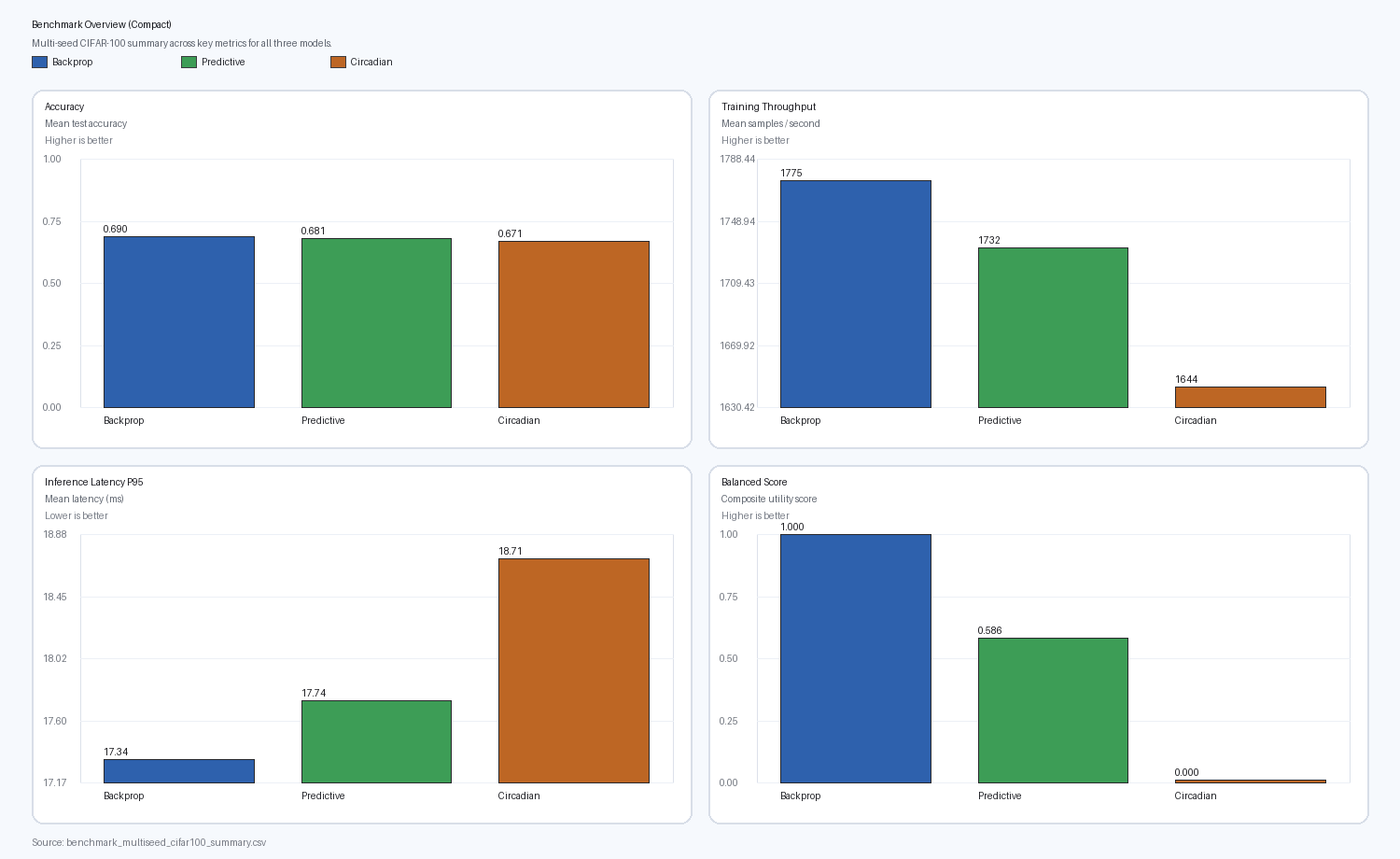
In a single-seed, 48-epoch CIFAR-100 run, circadian predictive coding reached 73.4% accuracy versus 72.3% for predictive coding and 70.6% for backpropagation. Its hidden layer moved from 384 to 394 units through 12 splits, two prunes, and seven guarded rollbacks.
In the latest 12-epoch subset verification, predictive coding led circadian 69.2% to 68.5%, and the circadian model trained more slowly. Both results are published because the behavior depends on regime, seed, and configuration.